


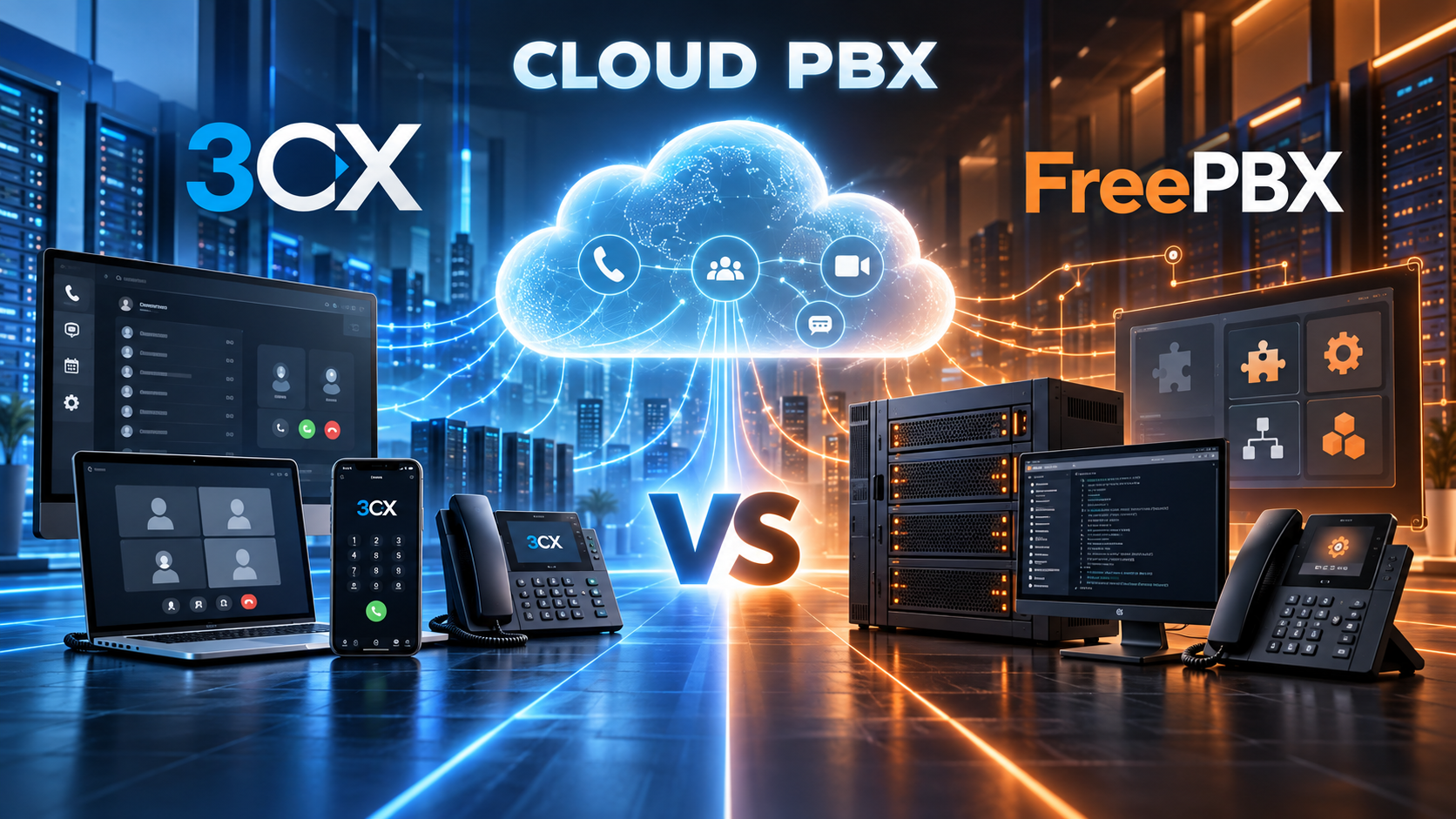
Two philosophies, one goal: reliable business telephony
Choosing a cloud PBX isn't just a technical exercise — it's a strategic decision that shapes your communication infrastructure for years. 3CX and FreePBX represent two fundamentally different approaches to business telephony. Both are battle-tested, but they suit very different organisational profiles. This guide cuts through the noise so your IT team can make an informed choice.
Architecture and deployment models
FreePBX is an open-source web GUI built on top of Asterisk, the world's most widely deployed telephony engine. It can run on-premise, on a bare-metal server, inside a VM, or on a private cloud instance — giving administrators complete control over every layer of the stack.
3CX follows a commercial model with a free tier (limited by simultaneous calls) and paid annual plans. It supports deployment on major public clouds (Google Cloud, AWS, Azure), private servers, and dedicated appliances. Its web-based management console is designed for speed: provisioning a new endpoint or configuring an IVR takes minutes rather than hours.
Key architectural differences:
FreePBX: maximum flexibility, requires Linux and Asterisk expertise
3CX: guided setup, automatic updates, significantly lower administrative overhead
Both support standard SIP trunking and modern codecs (G.711, G.722, Opus, SILK)
Unified Communications and third-party integrations
UCaaS features are now a baseline expectation for any modern business phone system. 3CX ships with softphones for Windows, macOS, and Linux; native iOS and Android apps; built-in video conferencing; team chat; and documented CRM integrations for platforms like Salesforce, HubSpot, and Microsoft 365 — all included without additional modules.
FreePBX takes a modular approach. Video conferencing, chat, and CRM connectors require third-party add-ons or custom development. For an experienced DevOps team, this granularity is an asset. For organisations without dedicated internal resources, it can slow down deployment significantly.
Typical use-case mapping:
SMB with 20–100 users and no in-house IT team → 3CX delivers faster time-to-value
Enterprise with a Linux-savvy IT team needing deep customisation → FreePBX provides unmatched control
High-volume call centres with complex IVR logic → FreePBX with advanced Asterisk dialplan scripting remains highly competitive
Security, patching, and vendor support
Security deserves more attention than it typically gets during PBX selection. FreePBX benefits from a large open-source community that identifies and patches vulnerabilities quickly — but the responsibility for applying those patches falls entirely on your system administrator. Misconfigured firewalls and publicly exposed admin panels are among the leading causes of SIP toll fraud incidents.
3CX experienced a notable supply-chain security incident in 2023 affecting its desktop client. The vendor responded with reinforced code-signing procedures and improved update delivery mechanisms — a reminder that commercial solutions are not inherently immune to vulnerabilities.
Regardless of platform, security best practices remain consistent:
Deploy Fail2ban or an equivalent intrusion prevention tool
Authenticate SIP trunks with IP whitelisting
Apply security patches within 72 hours of release
Monitor CDRs continuously for abnormal call patterns indicative of fraud
Total cost of ownership: beyond the licence fee
The economics of 3CX vs FreePBX rarely come down to licence cost alone. FreePBX is free to download and deploy, but the real TCO includes engineer hours for configuration and ongoing maintenance, third-party module costs, and the hidden cost of downtime if something breaks without a vendor support contract.
3CX licences are priced per simultaneous calls (SC) on annual plans. For organisations starting from scratch, the licence investment often pays for itself within months through reduced administrative workload and faster onboarding of new users.
FreePBX tends to offer better TCO when:
An internal Linux/Asterisk team is already in place
User volumes are high enough that 3CX SC licensing becomes costly
Deep customisations would require expensive commercial modules on 3CX
In either scenario, partnering with a reliable SIP trunk provider offering guaranteed QoS is critical — the PBX software is only as good as the voice connectivity underneath it.
Takeaways and next steps
3CX is the stronger choice for organisations prioritising ease of management, out-of-the-box UCaaS features, and structured vendor support — especially fast-growing SMBs.
FreePBX excels in enterprise environments with dedicated IT teams, advanced customisation requirements, or user volumes that make commercial licensing economically unattractive.
Regardless of which platform you choose, the quality of your underlying SIP trunk is the single biggest factor affecting call quality and uptime.
Not sure which platform fits your infrastructure? Get in touch for a free consultation — our engineers will assess your environment and guide you to the right solution with no sales pressure.